The Product Discovery Process: From Customer Problem to Validated Solution
Learn a practical product discovery process to validate ideas before building. Stop wasting dev time on features nobody wants.
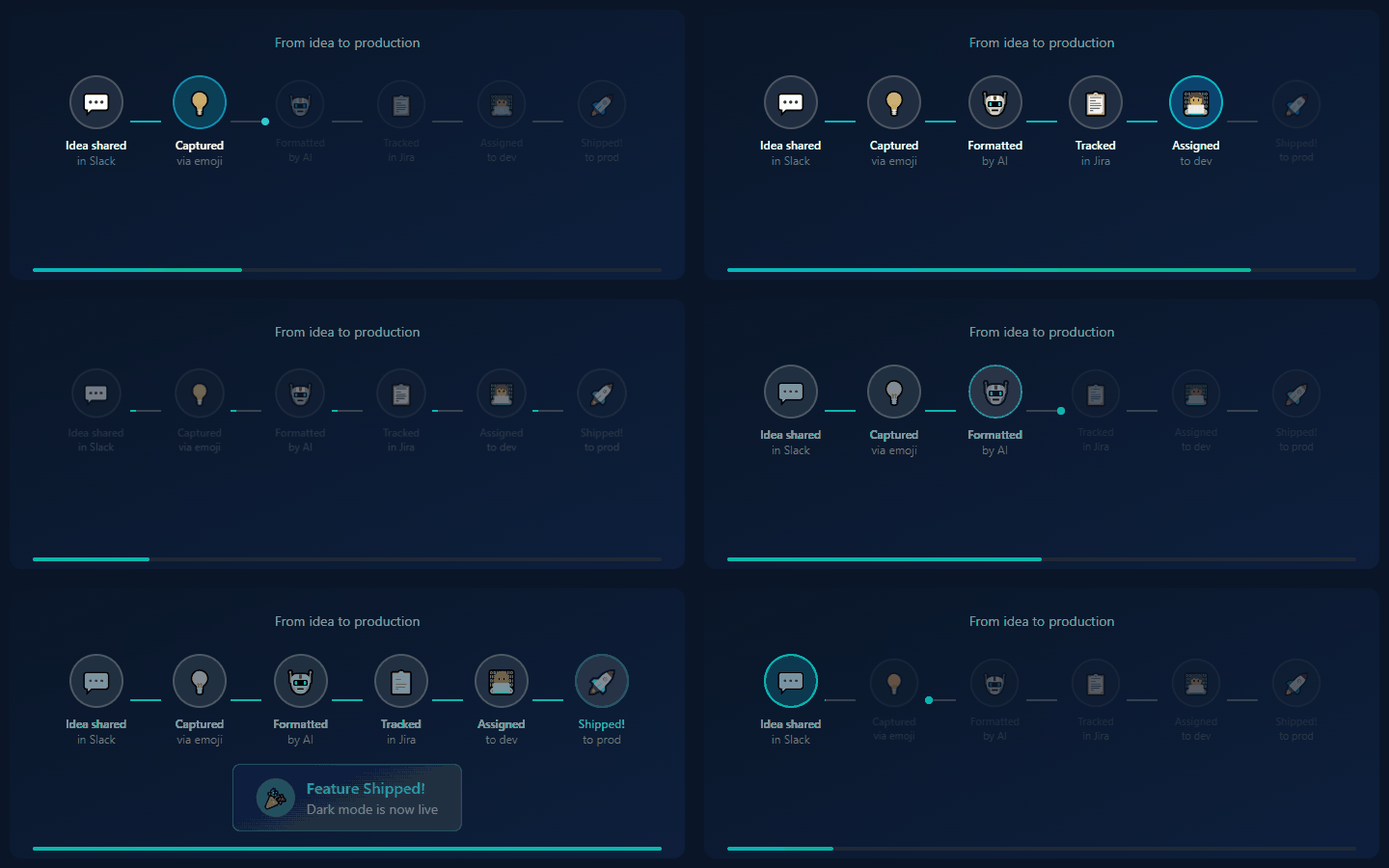
The most expensive feature is the one nobody uses.
Teams spend months building features based on assumptions. They launch. Users don't adopt. Engineering time wasted. Opportunity cost incurred. Morale damaged.
Product discovery prevents this. It's the process of validating that you're solving the right problem in the right way before you invest in building.
This guide walks you through a practical discovery process you can implement immediately.
What Is Product Discovery?
Product discovery answers two questions:
- Are we solving a real problem? (Problem validation)
- Will our solution work? (Solution validation)
It's the work before the work. Investigation before investment.
Discovery vs. Delivery
| Discovery | Delivery | |-----------|----------| | What to build | How to build it | | Experiments and prototypes | Production code | | Learning | Shipping | | De-risking | Executing | | Cheap and fast | Expensive and slow |
Good product work: Discovery → Delivery (validated → built) Bad product work: Idea → Delivery (assumption → built)
Why Discovery Matters
The Cost of Skipping Discovery
Consider: A team builds a feature in 3 months.
- Engineering cost: ~$150k
- Opportunity cost: Other features not built
- If it fails: Maintenance burden, technical debt
Now consider: The same team spends 2 weeks validating first.
- Discovery cost: ~$25k
- If the idea is bad: Kill it early, save $125k
- If the idea is good: Build with confidence
Discovery is insurance. It's cheaper to learn an idea is bad in 2 weeks than in 3 months.
When to Do Discovery
Always do discovery for:
- New product or major new capability
- Features requiring > 2 weeks of dev time
- Features targeting a new segment
- Features based on assumptions (not data)
- High-stakes bets
Skip formal discovery for:
- Bug fixes
- Performance improvements
- Obvious improvements with clear data
- Small iterations on existing features
The Discovery Process
Phase 1: Problem Discovery
Goal: Validate that the problem exists and matters.
Step 1.1: Capture Signals
Gather existing evidence of the problem:
| Source | What to Look For | |--------|------------------| | Feature requests | What are users asking for? | | Support tickets | What problems do users report? | | Sales call objections | Why don't prospects buy? | | Churn feedback | Why do customers leave? | | Usage analytics | Where do users struggle or drop off? | | Competitor analysis | What problems do others solve that we don't? |
Tools like IdeaLift help here: Aggregate feedback from Slack, Discord, support—see patterns across sources.
Step 1.2: Form a Problem Hypothesis
Write a clear problem statement:
Template:
[Customer segment] experiences [problem] when trying to [goal].
This causes [negative outcome] which leads to [business impact].
Example:
Enterprise customers experience data silos when trying to consolidate
reports across departments. This causes manual workarounds that take
hours weekly, leading to delayed decisions and potential churn.
Step 1.3: Validate the Problem
Test your hypothesis through:
Customer Interviews (Most Important)
- Talk to 5-10 customers facing the supposed problem
- Ask about their current workflow, pain points, workarounds
- Listen more than you talk
- Avoid leading questions
Interview Questions:
- "Walk me through how you currently handle [task]."
- "What's the hardest part about that?"
- "What have you tried to solve this?"
- "How often does this problem occur?"
- "What happens when this goes wrong?"
Survey Validation
- For quantitative confirmation
- "How much time do you spend on [task] weekly?"
- "Rate the difficulty of [problem] 1-10"
Usage Data Analysis
- Where do users drop off?
- What features are underused?
- What workarounds exist?
Step 1.4: Problem Scorecard
After research, assess:
| Criteria | Score (1-5) | |----------|-------------| | Problem is real (users confirm) | | | Problem is painful (high severity) | | | Problem is frequent (happens often) | | | Users actively seek solutions | | | Large enough market size | |
If total < 15: Problem might not be worth solving. If total > 20: Strong problem—proceed to solution discovery.
Phase 2: Solution Discovery
Goal: Find the right solution and validate it will work.
Step 2.1: Generate Solution Options
Don't jump to the first solution. Generate multiple:
Brainstorm techniques:
- Crazy 8s: 8 ideas in 8 minutes (forces quantity)
- How Might We: "How might we help [user] achieve [goal]?"
- Competitive analysis: What do others do?
- Analogy: How do other industries solve similar problems?
Aim for: 3-5 substantively different approaches.
Step 2.2: Assess Solution Risk
Every solution has risks. Identify them:
| Risk Type | Question | |-----------|----------| | Value | Will users want this? | | Usability | Can users figure it out? | | Feasibility | Can we build it? | | Viability | Does it work for the business? |
Rate each solution on these dimensions. Highest risk areas need the most validation.
Step 2.3: Prototype and Test
Create the cheapest artifact that tests your riskiest assumption:
| Risk | Prototype Type | |------|----------------| | Value | Landing page, explainer video, fake door test | | Usability | Wireframes, clickable prototype, Wizard of Oz | | Feasibility | Technical spike, proof of concept | | Viability | Pricing page test, financial model |
Prototype fidelity ladder:
| Fidelity | Cost | Use When | |----------|------|----------| | Sketch/wireframe | Hours | Early exploration | | Clickable prototype | Days | Usability testing | | Fake door test | Hours | Demand validation | | Wizard of Oz | Days-weeks | Complex workflow testing | | MVP | Weeks | Full validation before scale |
Step 2.4: Run Experiments
Test prototypes with real users:
Usability Test (for usability risk)
- Show prototype to 5 users
- Ask them to complete specific tasks
- Note where they struggle
- Iterate on design
Fake Door Test (for value risk)
- Create a button/link for the feature that doesn't exist
- Measure clicks
- Show a "coming soon" message + waitlist signup
- High clicks = demand exists
Wizard of Oz (for complex workflows)
- User thinks they're using the feature
- Behind the scenes, humans do the work manually
- Tests if the value proposition works before building automation
Concierge (for service-like features)
- Manually deliver the value to a few customers
- Learn what actually helps them
- Then automate what works
Phase 3: Solution Validation
Goal: Confirm the solution is worth building at scale.
Step 3.1: Define Success Metrics
Before building, agree on what success looks like:
Example metrics:
- Adoption: X% of users try the feature within 30 days
- Retention: Y% of users continue using after 60 days
- Task completion: Z% success rate on core workflow
- Time saved: Reduces task time by W%
Write a hypothesis:
We believe [solution] will result in [outcome].
We will know we're right when we see [metric] reach [target].
Step 3.2: MVP Scoping
What's the smallest version that validates the hypothesis?
Cut ruthlessly:
- What's the core value? (Keep)
- What's nice-to-have? (Cut)
- What's polish? (Cut)
- What can be manual initially? (Manual)
MVP ≠ Prototype: An MVP is shippable, usable software. It's the smallest thing that delivers value to real users.
Step 3.3: Build and Measure
Ship the MVP. Measure against your success metrics. Learn.
If metrics hit: Invest more. Iterate and improve. If metrics miss: Dig into why. Pivot or kill.
Continuous Discovery
Discovery isn't a phase—it's an ongoing practice.
Weekly Activities
| Activity | Time | Purpose | |----------|------|---------| | Customer interview | 30-60 min | Stay connected to problems | | Feedback review | 15 min | Surface patterns | | Assumption testing | 30 min | Validate beliefs |
Teresa Torres (Continuous Discovery Habits) recommends: At least one customer interview per week. Not quarterly. Weekly.
Embedding Discovery in Your Workflow
Before sprint planning:
- Is this feature validated?
- What's the hypothesis?
- What are the success metrics?
During development:
- Usability testing of in-progress work
- Early access for power users
After launch:
- Measure against hypothesis
- Conduct retrospective: What did we learn?
Common Discovery Mistakes
Mistake 1: Skipping Straight to Solution
Team sees a feature request and starts building. No validation that it's the right solution—or even a real problem.
Fix: Always start with "Is this a real problem?" before "How do we solve it?"
Mistake 2: Validating with the Wrong People
Talking to enthusiastic users who love everything. Or internal stakeholders who aren't users.
Fix: Talk to representative users, including skeptics and non-users.
Mistake 3: Asking Leading Questions
"Wouldn't it be great if we had [feature]?" Of course they say yes.
Fix: Ask about current behavior, not hypothetical preferences. "How do you handle [task] today?"
Mistake 4: Confirmation Bias
Looking for evidence the idea is good. Ignoring evidence it's not.
Fix: Actively seek disconfirming evidence. Ask: "What would make this fail?"
Mistake 5: Over-Researching
Discovery paralysis. Never confident enough to build.
Fix: Set time boxes. "We'll research for 2 weeks, then decide." Imperfect decisions are better than no decisions.
Tools for Discovery
| Activity | Tool Options | |----------|--------------| | Feedback aggregation | IdeaLift, ProductBoard, Canny | | User interviews | Zoom, Loom (async), Calendly | | Prototyping | Figma, Whimsical, Miro | | Fake door tests | LaunchDarkly, Split | | Usability testing | Maze, UserTesting, Lookback | | Survey | Typeform, Google Forms | | Analytics | Amplitude, Mixpanel, Heap |
Discovery Artifacts
Opportunity Solution Tree
Visual map connecting:
- Outcome: Business/user goal
- Opportunities: Problems to solve
- Solutions: Possible approaches
- Experiments: How to validate
                 [Increase Retention]
                         │
          ┌──────────────┼──────────────┐
          ▼              ▼              ▼
    [Slow Reports]  [Data Silos]  [Learning Curve]
          │              │              │
     ┌────┴────┐    ┌────┴────┐    ┌────┴────┐
     ▼         ▼    ▼         ▼    ▼         ▼
 [Cache]   [Export] [API]   [Auto-sync] [Tour] [Templates]
One-Pager
For each major initiative:
PROBLEM
Who has this problem? What evidence do we have?

HYPOTHESIS
We believe [solution] will [outcome] for [segment].

RISKS
- Value: Will users want it?
- Usability: Can they use it?
- Feasibility: Can we build it?

EXPERIMENTS
- Week 1: [Experiment to test highest risk]
- Week 2: [Next experiment if previous passes]

SUCCESS METRICS
- Primary: [Metric] reaches [Target]
- Secondary: [Metric] reaches [Target]

DECISION
Build / Pivot / Kill by [Date]
Getting Buy-In for Discovery
Objection: "We Don't Have Time"
Response: We don't have time to build the wrong thing. Discovery is faster than rework.
Data: Share an example of a feature that failed. How much time was wasted? What would 2 weeks of discovery have revealed?
Objection: "Customers Are Asking for It"
Response: Customers asking doesn't mean we've found the best solution. Let's validate our approach.
Compromise: Start with lightweight validation—3-5 interviews, a quick prototype test.
Objection: "We Already Know the Market"
Response: Every assumption should be testable. If we're right, we'll confirm it quickly.
Approach: Frame discovery as risk reduction, not doubt.
Conclusion
Product discovery is the process of validating before building. It's cheap insurance against expensive mistakes.
The core practices:
- Capture signals from all feedback sources
- Validate the problem through interviews and data
- Generate multiple solutions before committing
- Prototype and test the riskiest assumptions
- Define success metrics before building
- Keep discovering continuously, not just once
Start with one interview per week and one prototype per month. Build the muscle.
Your future self—and your engineering team—will thank you.
Ready to capture the signals that drive discovery? Try IdeaLift free →
Related posts:
- The Complete Guide to Product Feedback Management
- How to Prioritize Feature Requests Without Going Crazy
- How to Close the Customer Feedback Loop
Ready to stop losing ideas?
Capture feedback from Slack, Discord, and Teams. Send it to Jira, GitHub, or Linear with one click.
Try IdeaLift Free →